160 meters, transmit
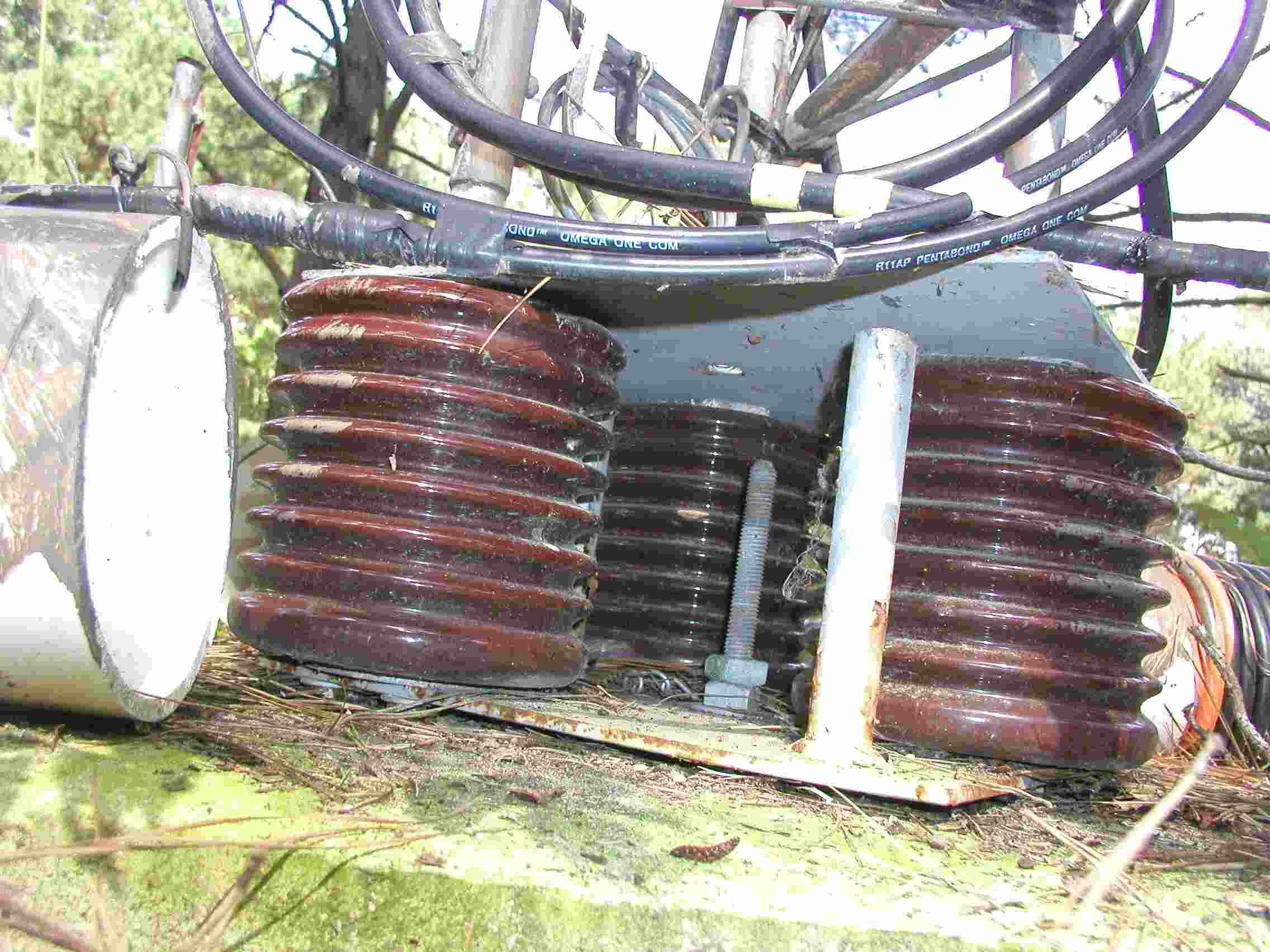
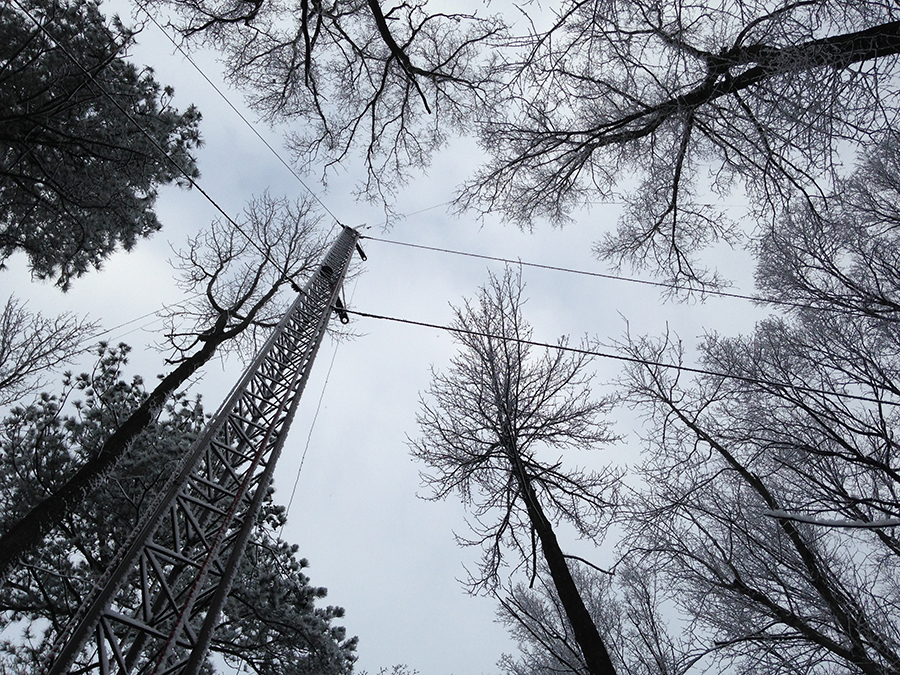
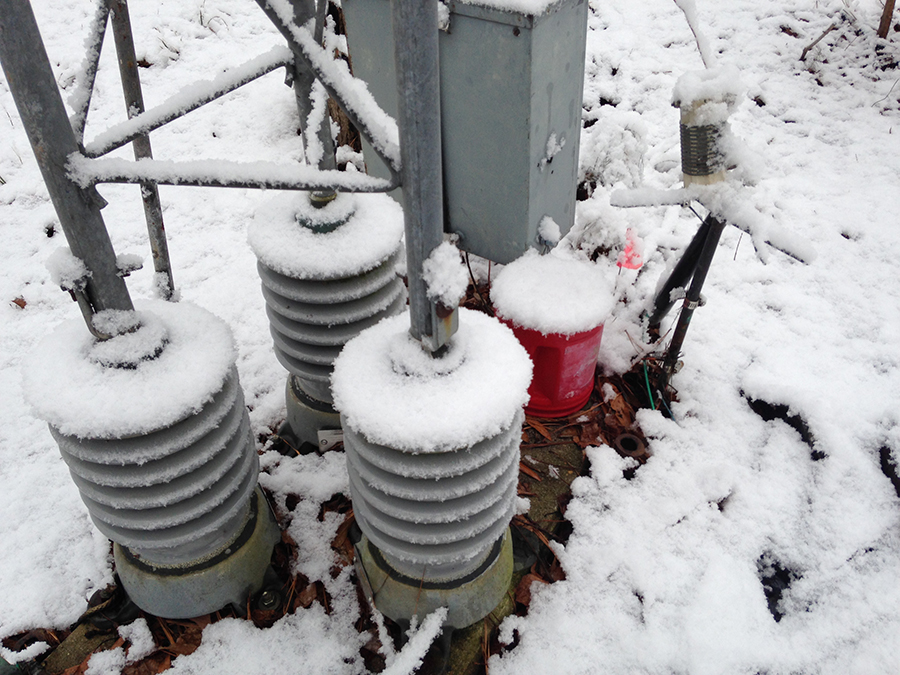
K3LR-inspired parasitic vertical array. Rohn 25 driven element, sits on insulators and series-fed through L network matching. Sloping T-shaped wire parasitic elements supported by rope catenaries, each spaced 66 feet from tower, are used as 3-element vertical yagi to give about 5 db gain and 25 db f/b in four selectable directions: NE, NW, SE, SW. Relays at base of each element ground parasitic wire for director, add coil to ground for reflector (resonates element just below 1800 kHz), or floats for omni pattern. 120 slightly buried quarter-wave radials under each element. Three elements active at one time; other two are left floating (above ground) and thus electrically invisible to the active elements. Additional wide-spaced second director element toward NE (Europe) adds about 1 db gain in that direction.
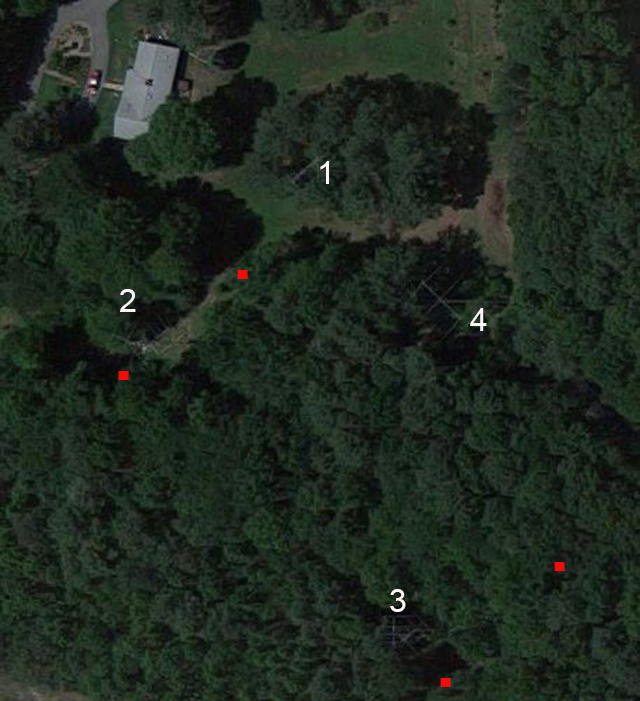
WW2Y-inspired broadside/endfire array. 325 feet broadside, 148 feet endfire spacing. Broadside pattern oriented northeast/southwest, soon to be switchable with about 8 db gain over a single element. One element is shared with the parasitic array (relay-switched between the two arrays) and other three are other T-shaped wires hung from loblolly pine trees and towers. About 73 feet vertical with 58 feet in the top-hat – resonant around 1930 kHz. Small coil at base to resonate around 1830 kHz. Initally the two rearward elements (bottom two red dots in photo at left) were simply tuned as parasitic reflectors until I get to the phasing to make switchable NE/SW.
80 meters
The “forgotten band” at AA1K. For many years I’ve used a single inverted vee with apex at 95 feet, hung on the 15 meter tower. Around 2017 I erected four quarter-wave wire vertical elements, hung from trees in a broadside/endfire array centered within the 160 meter broadside/endfire array. The 80 meter elements simply tie in to a single radial wire that passes nearby from the 160 array. Spacing on the 80 meter elements is such that this may be expanded to a full 8-circle array someday. For now it favors Europe and the rearward two elements are loaded to use as parasitic reflectors.

40 meters
The latest addition to our yagi collection, in September 2025, is a JK Antennas 404 Grande. This is four full-size elements on a 44′ boom. This formerly resided at K4WMS (SK) in Virginia, and had been assembled here for about a year until son Adam N3TTT and I found time to tram it to the top of the Rohn 55 tower. The rotor is an M2 OR2800. Previously, we had an Eantennas 40MDY3 at the top, and before that a stack of HyGain 7-3 Discoverer yagis. One of those remains (at 60 feet) to be used in combination with the Grande.
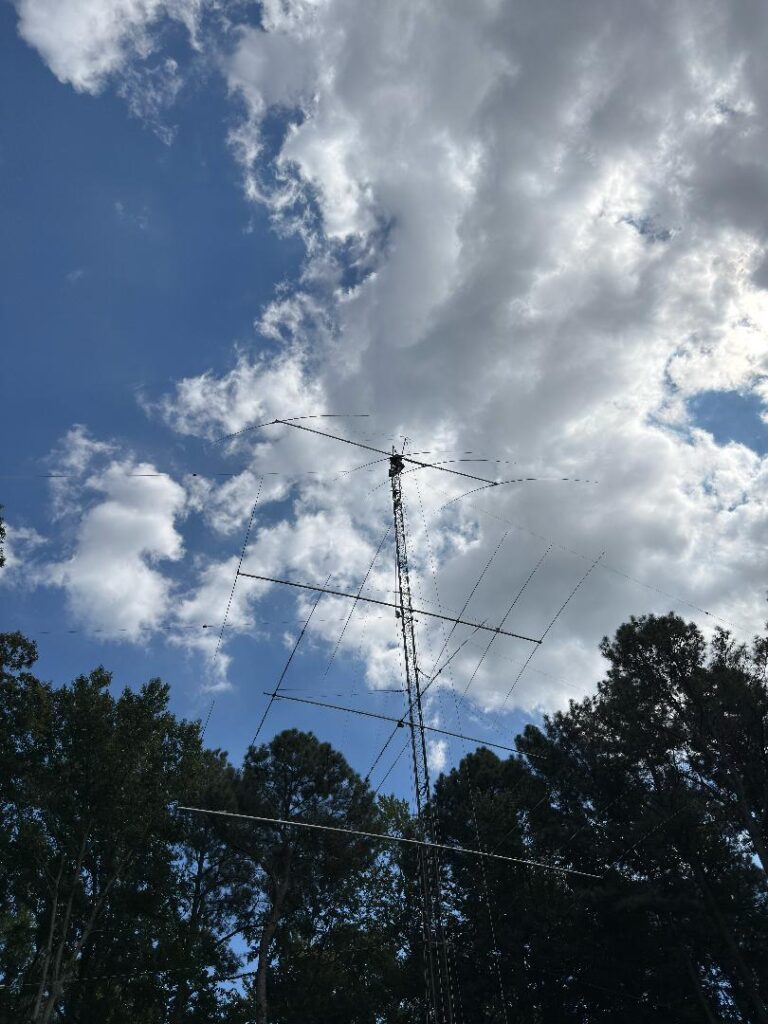
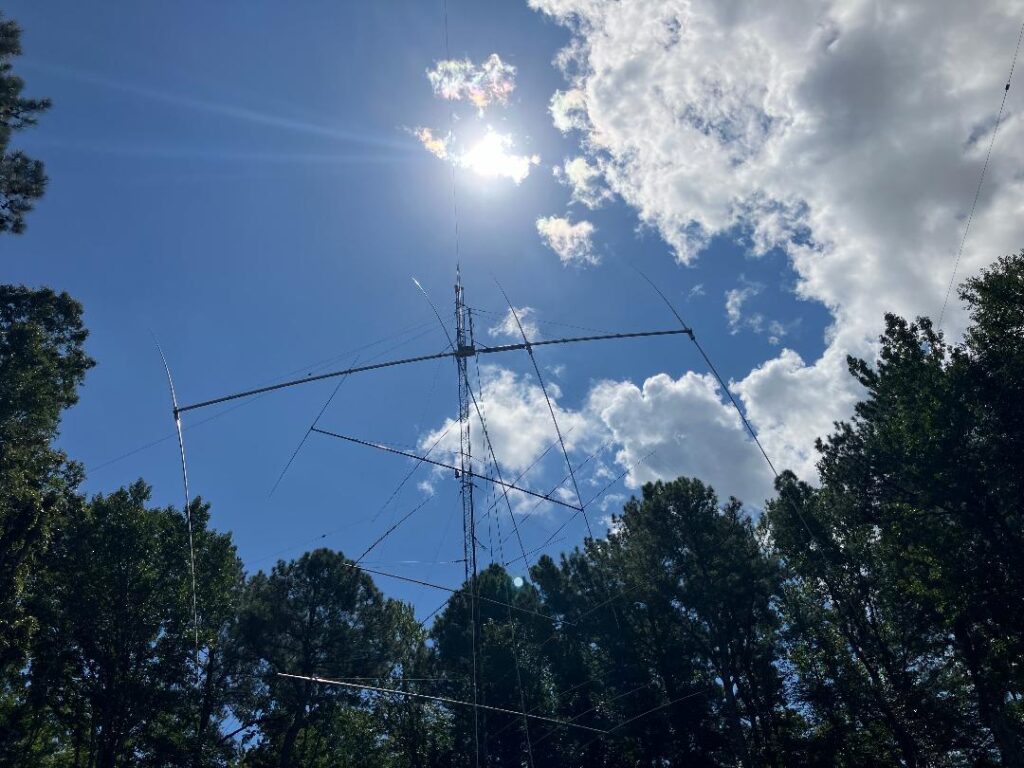
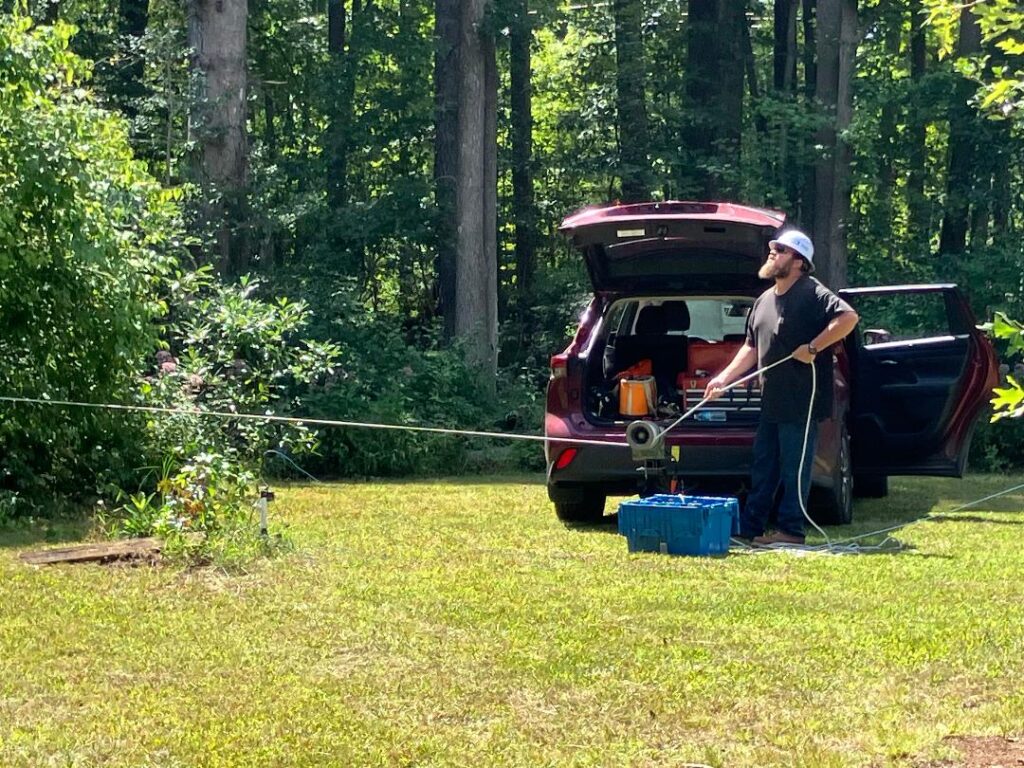
On three other towers that are on a line broadside to Europe, we tried an array of three 2-element loaded yagis (Cushcraft XM240’s on the outside at 83 feet and Force 12 Delta 240 at 75 feet in the middle), all fixed on Europe in a broadside “stack.” While modeling predicted superior performance the results were disappointing.
20 meters
Three stacked Hy-Gain 204BA yagis (4 elements on 26-foot boom) on Rohn 45 tower. Top rotates with T2X Tailtwister rotor; bottom two are fixed on Europe. This has performed quite well and the third beam makes for excellent front-to-back performance. In 2019 I installed a stack of two M-Squared 5-element 20 meter beams (44-foot boom) at 79 and 41 feet on the Rohn 55 that now holds the JK 404 Grande. This stack, fixed on Europe, was usually even-up or only slightly better when compared with the 204BA stack. When we put up the JK 404 Grande, the M-squared stack was fixed at 162 degrees and does quite well for South America and the Caribbean.
15 meters
Two stacked Wilson 415M yagis (4 elements on 17-foot boom) on Rohn 25 tower (tower 3) were used since about 2000. These were replaced in 2020/2021 on a new Tower 8, 90 feet of Rohn 55. I purchased three Force 12 Magnum 715 (7 elements on 44-foot boom) yagis from the N3HBX contest station being dismantled in Maryland. The top antenna at 91 feet rotates with an Orion rotator. The bottom two, at 32 and 62 feet, are fixed on Europe. An Array Solutions WX0B StackMatch is used for selecting any combination of the three yagis, using Green Heron Everywhere controller. There is a definite improvement over the original Wilson stack.
10 meters
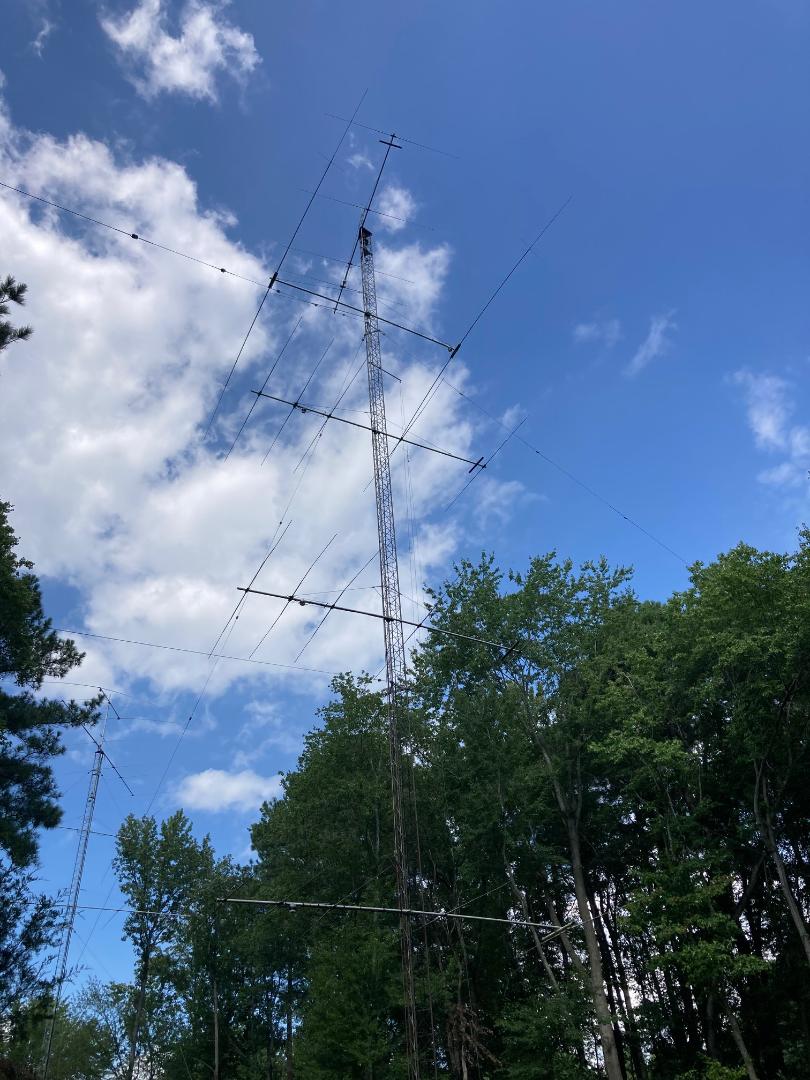
My latest antenna upgrade began in November 2022, installing 100 feet of Rohn 45 to replace the 100 foot Rohn 25 that held the old 15-meter Wilson stack (tower 3). This new tower was completed in October 2023 with a four-stack of modified HyGain 105BA 5-element yagis at 22, 44, 66 and 100 feet. A Green Heron Engineering Four Stack Hamplus controller is used for selecting any combination of the four antennas. This array replaces a single modified Hy-Gain 105BA at 48 feet that had been used for several years. The antennas are 5 elements on 26-foot booms, using the N6BV optimized OWA dimensions from the ARRL Antenna Book.
10-12-15-17-30 meters
I obtained an M-Squared 17-10 log periodic yagi (26 foot boom) in a package deal with some other antennas and decided to try it on the 10-meter tower temporarily, at 42 feet high (the 10-meter was taken down for refurbishing after some tree damage). It is my first dedicated WARC band yagi, and I also installed a 30-meter wire dipole at the top of this tower. The LP works well on the WARC bands, and it is not as good as my monobanders on 15 meters, as expected. It did well on 10 meters in the CQ WW DX SSB and CW contests in 2019. The 17-10 LP is now atop Tower 1.
6 meters
A few years ago I built a single 5-element yagi, 24-foot boom and put up at 100 feet on the 160m driven element tower. That replaced a 4-element 6m yagi on 12 foot boom that had helped me achieve DXCC on 6m. It also serves as top loading for the 160-meter driven element (Tower 1). In 2020, I rebuilt an old Cushcraft A50S with the W5WVO mods, extending the boom to 17.5 feet and changing the element lengths and spacing. This went on the mast of Tower 7 at about 43 feet high, a few feet below the 10m yagi, and has performed well.
2 meters
A 3 element 2m vertical yagi fixed south high on the 160m driven element is used by the AA1K-10 node on 145.05.